How to Tell What Band Your Phone Is Using
Figuring out your LTE (4G) connexion's blazon and signal strength can help diagnose network or connectivity problems, but Android'south not very helpful with this out of the box. Thankfully, in that location are apps that will give you lot a bit more insight, and our favorite is a free download. Signal Spy is a unproblematic, free tool that quickly and hands presents your current mobile network condition including the connectedness technology (EDGE, HSPA, LTE), network ring, signal force, and carrier.
(And no, this isn't a paid post - nosotros get no money from Signal Spy, and we haven't cooperated with them in writing this guide. It's just a practiced, like shooting fish in a barrel to use app.)
How to use Betoken Spy
First, you'll demand to download it from the Play Shop - hither's a link.
From in that location, just open up the app, and it will provide you your current carrier, the connectedness technology, band (frequency), and signal strength. You'll need to provide the app telephony and location permissions for it to office properly, but bated from that, information technology'due south pretty plug and play: information technology should begin pulling your connection information immediately, and in a matter of seconds display it to y'all, every bit below.
How to interpret LTE ring / frequency and indicate force
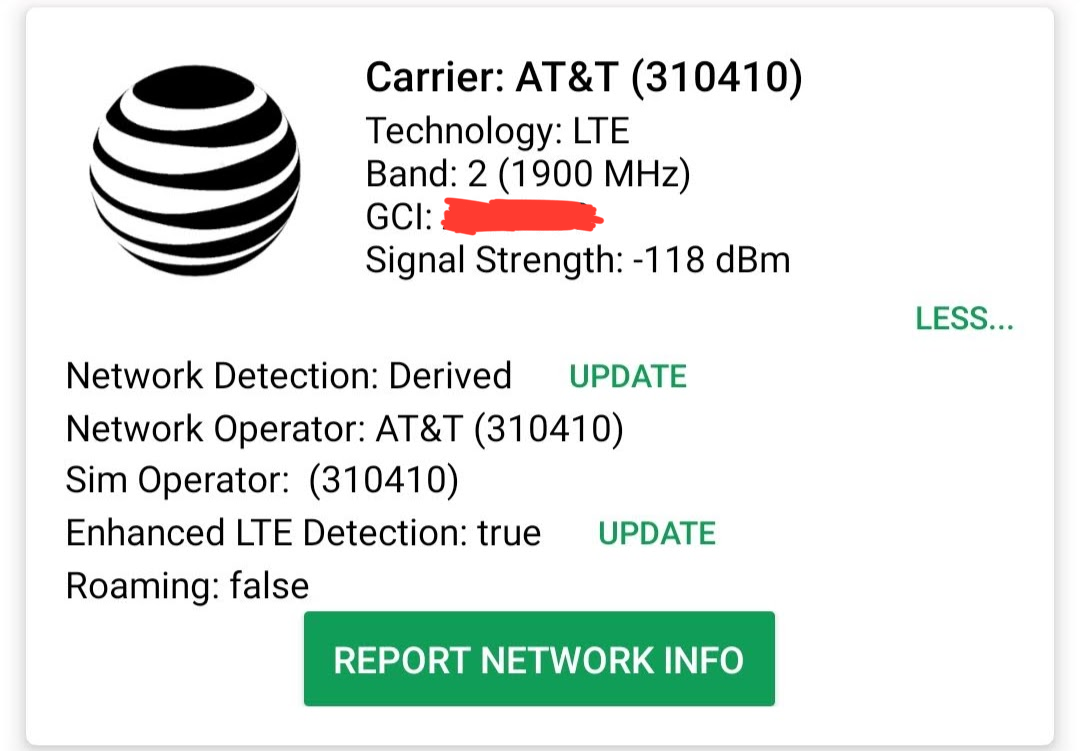
Interpreting the information Signal Spy provides really depends on what you seek to get out of it. If you're trying to verify whether your smartphone is connecting to a given LTE band in a certain location, for example, the app can even record your connectedness status and allow you to review it if you opt for the "pro" version - which is but a $2 in-app purchase. When you go a new smartphone, peculiarly if yous're coming from an older handset, it's possible your new phone will back up LTE bands your old smartphone didn't. You can bandy SIM cards between your devices and, using the app, see which ane each phone connects to.
Point strength is a measure of how consistent and stable your connection to the cellular network is. If y'all're dropping calls or losing data connectivity in sure places, monitoring the point strength in real fourth dimension could help yous decide where your worst expressionless spots are. How weak is "too weak" to be usable? That really depends, but if your phone is reporting indicate of -110dBm or "lower" (remember, gain is measured in the negative, and then a "bigger" number like -110dBm is worse than -90dBm), it'due south likely your data reception is pretty bad.
Yous may likewise wonder what the "GCI" number in the list is - it's essentially the identifier for the cellular tower you're currently continued to. It doesn't really tell yous much on its own, simply could help if you were doing some advanced troubleshooting with your carrier, I suppose.
Tin can I trust this app?
An app that monitors your phone'due south mobile signal should be trustworthy. Signal Spy does require the location and telephony permissions in order to run properly. Y'all can read more about them on Signal Spy's FAQ.
The telephony permission allows Signal Spy to read from your phone's telephony status in real time, and is apparently necessary to report the data the app gives you.
The location permission allows Point Spy to retrieve more accurate band and engineering science information utilizing the "coarse" location permission which pulls information from nearby cellular towers. While Signal Spy will work with the location permission disabled, information technology may not accurately written report band (frequency) data.
Indicate Spy does collect more detailed anonymous data about your connectivity ifyou plow on the "enhanced LTE detection" feature. This feature volition report your currently connected tower information to Signal Spy anonymously to aid meliorate its LTE detection database, and besides potentially provide you more than upward to date and accurate results when using the app. It is turned off by default, and is completely optional to use the app.
Every bit far every bit general data privacy goes, Signal Spy'south privacy policy can be found here, and they do share your anonymized device data to serve yous advertisements and perform analytics most app usage. This is common practice for many mobile applications, and nosotros've seen nothing to engagement almost Signal Spy abusing user privacy.
Other options
There are other apps that tin can provide similar information about your LTE signal, but we like Signal Spy because information technology'southward elementary and the developers do a practiced job keeping it up to engagement. Still, here are a couple other options to explore.
Network Cell Info Lite provides more than detailed information than Signal Spy, though its interface is very... busy. Only, some people may like the more graphically-focused data presentation of this app, and the Pro version allows logging and a few other features you may detect worth $2. The Lite version of the app is linked below.
LTE Discovery is similar to Signal Spy in terms of data representation, but does provide a bit more than context to some of the data (like exact uplink and downlink frequncies). It likewise can just show your currently connected LTE band in the status bar - something people may detect convenient.
Well-nigh The Author

catalanoshery1976.blogspot.com
Source: https://www.androidpolice.com/2019/04/13/how-to-check-your-lte-4g-band-signal-strength-and-more-on-android-phones/
0 Response to "How to Tell What Band Your Phone Is Using"
Post a Comment